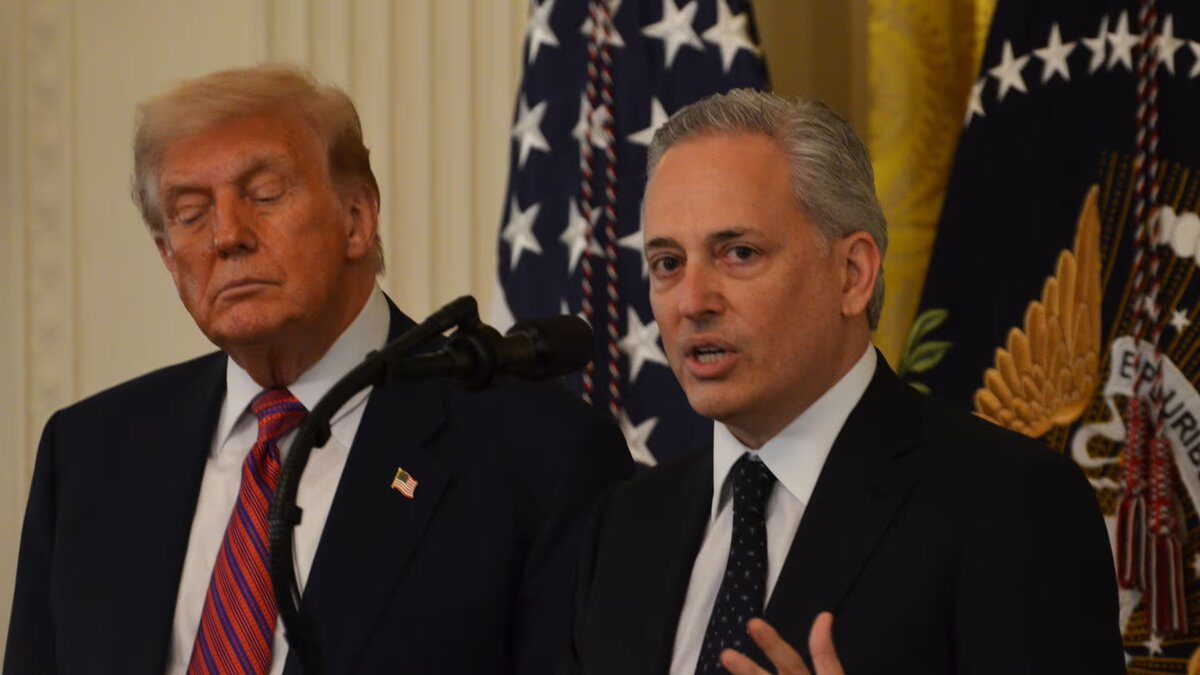
The architect of the Trump administration’s early crypto policy moves is changing roles — but staying close to the centre of U.S. technology and innovation strategy.
David Sacks, who has served as the White House’s AI and Crypto Czar since before President Trump retook office in January 2025, announced Thursday that he is transitioning out of the czar role and into a new position as co-chair of the President’s Council of Advisors on Science and Technology, known as PCAST.
The move ends Sacks’ tenure in one of the more unusual roles the administration created — a dual AI and crypto portfolio held by a Silicon Valley venture capitalist — but keeps him in an influential advisory position at the intersection of technology and federal policy.
Why the Role Changed
The transition is partly structural. Sacks explained in an interview with Bloomberg that his czar position was designated as a special government employee role, a classification that legally limits service to 130 working days. Democratic lawmakers had already raised concerns last autumn that Sacks had exceeded that threshold, making a formal role change both legally necessary and politically convenient.
The PCAST co-chair position carries no equivalent restriction, giving Sacks a more durable platform from which to influence technology policy without the legal constraints that had begun to complicate his czar tenure.
What Sacks Accomplished in the Czar Role
During his time as crypto and AI czar, Sacks oversaw the White House’s early-stage work on digital asset policy, including the passage of the GENIUS Act — the administration’s flagship stablecoin legislation — and more recently, the development of a broader crypto market structure bill that is still working its way through the legislative process.
His tenure represented a significant shift in Washington’s posture toward the crypto industry, moving from the adversarial regulatory environment of the prior administration toward active engagement with industry stakeholders and an explicit pro-innovation policy agenda.
What PCAST Will Focus On
Sacks described PCAST as the principal body of external advisors responsible for shaping science, technology and innovation policy for the President and the wider White House operation. The council’s initial membership reads like a who’s who of the U.S. technology industry.
Confirmed members include Andreessen Horowitz co-founder Marc Andreessen, Google co-founder Sergey Brin, Dell founder Michael Dell, early Coinbase backer Fred Ehrsam, Nvidia CEO Jensen Huang, AMD CEO Lisa Su and Meta founder Mark Zuckerberg. Michael Kratsios, who has served in both of Trump’s administrations in senior technology policy roles, will serve as co-chair alongside Sacks.
In terms of focus areas, Sacks indicated PCAST will prioritise artificial intelligence — including advancing the AI policy framework the administration released last week — alongside quantum computing, nuclear power and other areas the council described as cutting-edge technologies. Notably, Sacks did not mention cryptocurrency in his Bloomberg interview, a signal that his personal policy focus may be shifting toward AI and deep tech as those areas attract greater federal attention.
What This Means for Crypto Policy
The immediate question for the digital asset industry is whether Sacks’ departure from the czar role creates a gap in crypto’s White House advocacy infrastructure, or whether the policy groundwork already laid — including the stablecoin legislation and market structure bill — is sufficiently advanced to proceed without a dedicated czar-level champion.
The answer is likely somewhere in between. The GENIUS Act’s passage and the ongoing market structure discussions represent meaningful progress, but cryptocurrency regulation in the United States remains an unfinished project with several consequential legislative and regulatory decisions still pending. Whether a successor to the czar role is named, or whether crypto policy is absorbed into a broader technology portfolio, will shape the industry’s relationship with the executive branch over the next phase of the administration.
What is clear is that Sacks himself remains embedded in the administration’s technology policy apparatus. His presence on PCAST, alongside some of the most influential figures in U.S. tech, ensures that the broader innovation agenda — within which crypto sits — continues to have a strong Silicon Valley voice at the table.